Content
Your Website Launched and Nobody Visits: A 90-Day Plan for Kenyan Businesses
 By Nemo Kimani27 Oct 20267 min read
Key takeaways
- A new website is a starting line, not a finish. Search engines need time and reasons to send people to it.
- Plan 90 days: the foundation first, then the first content and social, then email and a refresh.
- Social carries each piece further and email keeps the people who are not ready to buy yet.
- Measure rankings for a short list of real searches, not total visitors alone.
The site launched. The photos are lovely. The developer sent a link and a congratulations.
Then a month went by and almost nobody visited.
This is the most common story we hear, and it is not a sign that the site is bad. It is a sign that launching and being found are two different jobs. Here is the plan we use for the second one.
Why is my website not getting traffic after launch?
A new site gets little traffic because search engines have not yet learned what it is about, who it is for or whether to trust it, and because nothing is bringing people to it yet. A launch adds the pages. It does not add the content, the signals or the audience that send visitors.
The fix is a steady plan, not a one-off push. That is what the next 90 days are for.
How long does it take for a new website to show up on Google?
Google can index a new site within days to a few weeks, but showing up for the searches that bring customers usually takes months. Searches for your own brand tend to move first. Specific, narrow searches come next. Broad, competitive ones take longest, and some you may never need.
| When | Focus | What you should have by the end |
|---|---|---|
| Days 1 to 30 | Foundation | A keyword map, the five core pages rewritten around real searches, a verified Google Business Profile, tracking in place |
| Days 31 to 60 | First content and social | Four to eight helpful posts aimed at specific questions, each shared across your social channels |
| Days 61 to 90 | Email and refresh | A welcome email sequence, a list sign-up on your best pages, a first refresh of anything that is slipping, and a clear report |
What does a launch plan look like on a real site? TeleTherapyCounsellors
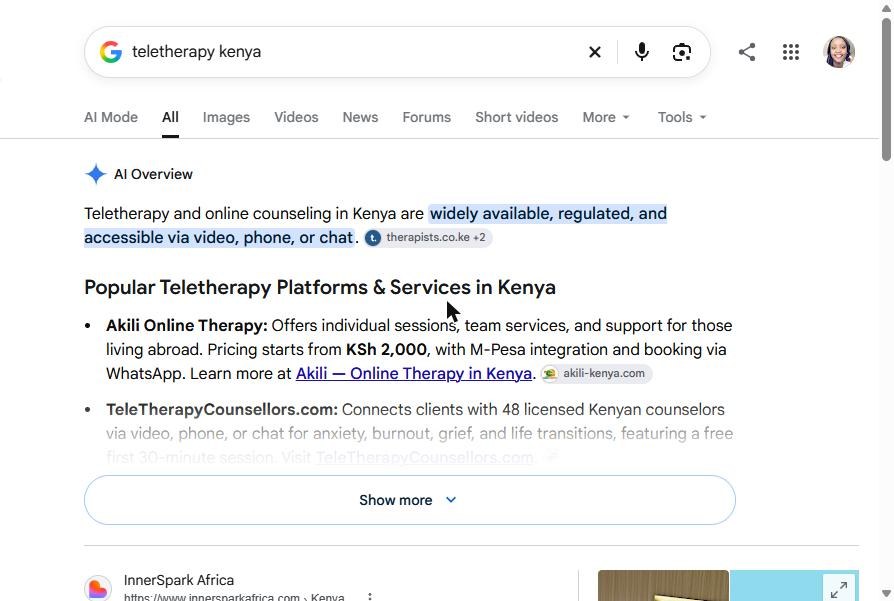
TeleTherapyCounsellors is the clearest example we have. The founder had a vision and a network of qualified Kenyan counsellors, but no website, no booking, no content and no search presence. It was built from a blank page into an online therapy platform for Kenyan women, and the search work ran alongside the build instead of waiting for it.
- A complete site: a therapist directory, booking, a service page for each type of therapy and a blog.
- Search structure from day one: a focus keyphrase, title and description for every page, schema for the directory and FAQs.
- A free guide for women starting therapy, with separate welcome email sequences for clients in Kenya and abroad.
- A blog calendar built around the searches women actually make.
The early result: number 2 for "teletherapy kenya", number 1 for the brand search, and Google's AI Overview describes the platform and its free first session. Bigger searches like "online therapy kenya" and "best online therapy kenya" are still targets, not wins, and we track them in the open on the Results page. That honesty is part of the plan too.
Start with the free roadmap
Five steps, one page, and a clear first week. Enter your email and we will send it.
What should I do in the first 30 days?
Build the base. Decide the 10 to 20 searches that matter, one main keyword per page, using the layers in our 5-layer keyword strategy. Rewrite your core pages around those searches. Claim and complete your Google Business Profile. Record where you rank today for your short list, so every later move is measured against a real baseline.
How often should I blog?
Consistency matters more than volume. For most small businesses, one to two helpful posts a week is realistic and enough to build a topic over time, and four a month is a fine start. Each post should answer one real question and link to the page it supports. Our content marketing service plans this calendar around the searches in your keyword map.
Want a 90-day plan for your own site? Book a call and we will outline it with you.
Does social media help SEO?
Social media does not directly raise rankings, but it carries each piece of content further, sends visitors, and helps people find and recognise your brand, which supports the entity layer. Use it to share each post in more than one way, and to learn which topics people respond to. Our social media strategy builds a plan you can keep up.
Is email marketing worth it for a small business?
Yes, because most visitors do not buy on the first visit. A short welcome sequence and a simple monthly note keep you in front of people who are interested but not ready. It is the quiet net under the rest of the work. We explain how it fits in email marketing.
How do I know it is working?
Track a short list of real searches and watch their positions, not only visitor totals. Add your Google Business Profile views, calls and form enquiries. We publish our own targets in the open on the Results page for the same reason. If you want to see the whole journey, read how it works, or use the quote calculator to see an estimate.
Turn your launched site into a working one
Send us your website. We will outline your first 90 days on a free call.
Want this done for your site?
Thirty minutes with Nemo. No pitch and no pressure, just an honest look at what your website needs next.