SEO
The 5-Layer Keyword Strategy for Kenyan Websites, From Short-Tail to AI-Search
 By Nemo Kimani6 Oct 20268 min read
Key takeaways
- Most keyword advice stops at two layers: short-tail and long-tail. A page that is meant to be found needs all five.
- The five layers are short-tail, long-tail, semantic, entity and AI-search keywords. Each does a different job.
- Plan every page with one keyword from each layer and you stop guessing what to write.
- Kenyan searches add a sixth thing to watch: English, Swahili and mixed phrasing, which we cover in a separate post.
A garage owner in Nairobi once told us, "I put 'Nissan repair' on every page and nothing happened."
He was not wrong to use the phrase. He was only using one of five layers, and the most crowded one.
This post is the method we use to plan every page, post and profile we write. It is the same method behind the results you can see on our Results page, and you can use it today without paying anyone.
What are the 5 types of keywords?
The five layers are short-tail, long-tail, semantic, entity and AI-search keywords. Short-tail is the broad head term, long-tail is the full question a buyer types, semantic keywords are the related words that prove you cover the topic, entity keywords tie your name to what you are known for, and AI-search keywords are the plain-language questions an AI summary would answer.
Most guides teach the first two and stop. The last three are where a small Kenyan site can still win, because very few competitors plan for them.
What is the difference between short-tail and long-tail keywords?
Short-tail keywords are one to two words, such as "SEO" or "wedding planner". Long-tail keywords are longer and specific, such as "intercultural wedding planner in Kenya". Short-tail brings more searches and far more competition. Long-tail brings fewer searches and much more intent, which is why it usually converts better.
| Layer | Example for a Nairobi garage | Its job |
|---|---|---|
| Short-tail | nissan repair | Signals the topic, hard to win alone |
| Long-tail | best nissan repair in nairobi | Wins the buyer who is ready to act |
| Semantic | diagnostic, genuine parts, certified mechanics, Note, X-Trail | Shows Google you cover the topic in depth |
| Entity | Aljarey Motors, Nissan specialist, Nairobi | Connects your name to the work |
| AI-search | Who is a trusted Nissan repair garage in Nairobi? | Gives an AI summary a clean answer to quote |
Get the free 5-Step Content Roadmap
The plan we use to turn a quiet website into one that brings in clients. Drop your email and it is yours.
What is a semantic keyword?
A semantic keyword is a word or phrase that is closely related to your main keyword and tells search engines what your page is really about. If your main keyword is "Morpheus8 Nairobi", the semantic layer includes "skin tightening", "acne scars", "downtime" and "melanin-rich skin". Google reads the whole neighbourhood of words, not one phrase repeated.
This is also why stuffing a keyword fails. One phrase repeated ten times covers one layer. A page that answers the questions around the phrase covers three.
What is entity SEO?
Entity SEO means helping Google understand who or what you are as a distinct, real thing, not only which words you use. An entity can be a business, a person, a place or a product. Google builds its picture of you from your website, your Google Business Profile, your social accounts and mentions elsewhere, so they all need to say the same thing.
You can see it working in a simple test. Search your own business name. If your site, your Instagram, your Facebook and your Google profile all show up together on page one, Google has recognised you as one entity. We cover the profile side in our guide to Google Business Profile for therapists, and the same steps work for any business.
Not sure which layer is missing from your site? Book a call and we will check it with you.
What is an AI-search keyword?
An AI-search keyword is a question written the way a person would ask it aloud, which an AI summary such as Google's AI Overview can answer in one or two clear sentences. "Who is the best Nissan repair garage in Nairobi?" is one. These are the questions people ask in the "People also ask" box and in voice search.
The practical rule is simple. Put the question in a heading, answer it in the first two sentences, then add the detail. We go deeper in how to show up in Google AI Overviews in Kenya.
Does the 5-layer method work on a real site? Vikkie Oh Atelier
Fashion is one of the hardest places to rank in Kenya. Marketplaces own the product searches, and global brands own the how-to-wear searches. Vikkie Oh Atelier, an Afropolitan fashion brand in Nairobi, had a clear point of view but a site that said it only on the home page. A ranking check at the start showed page-one results for the brand name and almost nothing else.
So we planned every page and post across all five layers, and we did not fight the marketplaces on broad terms like "Ankara dresses". Here is where each layer landed.
| Layer | The search | Where Vikkie Oh Atelier stands |
|---|---|---|
| Short-tail | afropolitan fashion | Page one at number 7, against Pinterest and international sites |
| Long-tail | afropolitan fashion kenya | Number 1, with a second page at number 4 |
| Semantic | ankara fit guide for kenyan women, afropolitan capsule wardrobe | Both posts are number 1, built around the words that surround the topic |
| Entity | vikkie oh atelier | The shop with sitelinks, plus Instagram and Facebook, all on page one |
| AI-search | what is afropolitan fashion | Number 1 right under the AI Overview, which answers the question |
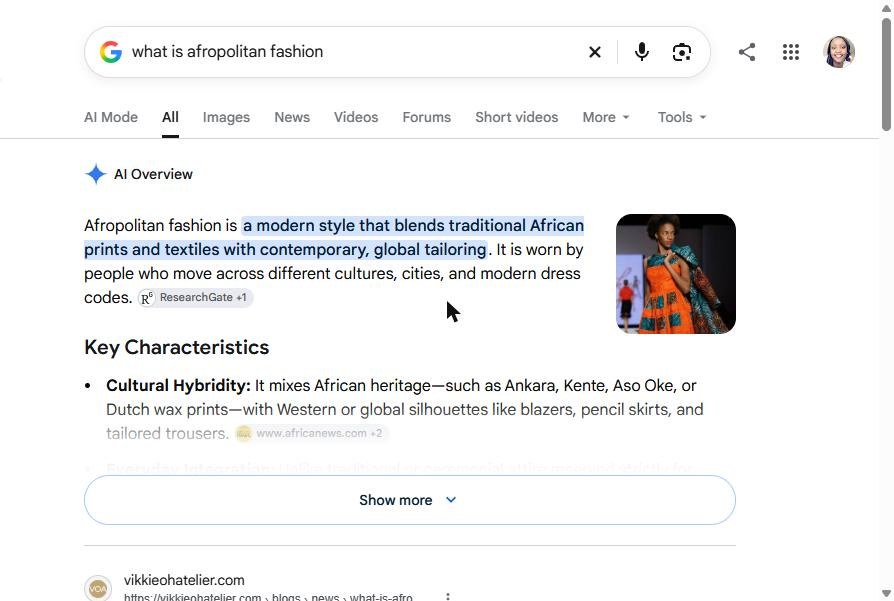
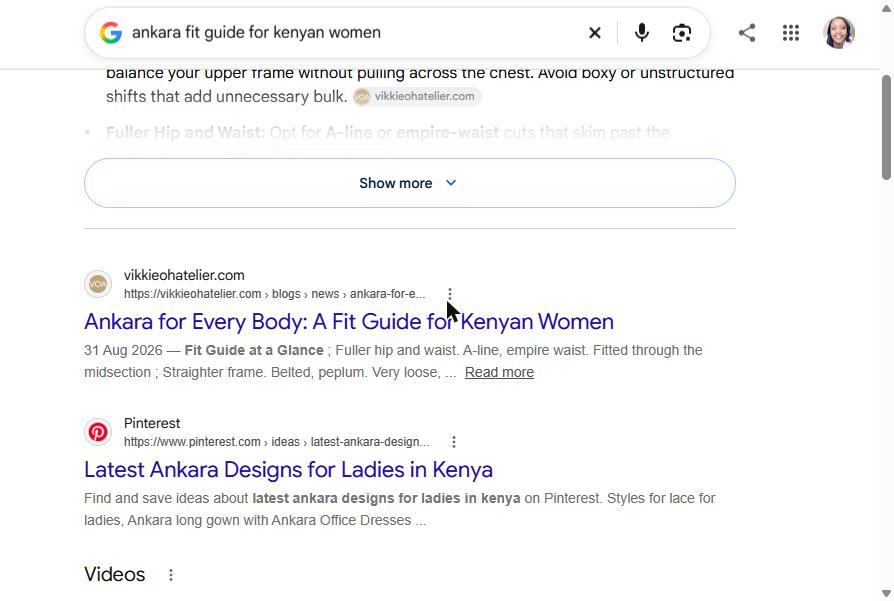
Broad fashion pages usually compete on the first two layers. The other three are where a small brand can stand out.
We wrote up the first three months in full in our post on what moved for a fashion brand on Google, including the posts still climbing.
How many keywords should one page target?
One page should target one main long-tail keyword, plus a small group of semantic, entity and question phrases that belong to the same topic. That usually means one primary keyword and five to ten supporting phrases on the page, not twenty unrelated keywords.
If two pages chase the same primary keyword they compete with each other. Give each page its own job and link them together.
How does this look across different Kenyan businesses?
The layers stay the same and the words change. Here is how we think about it for sectors we work in:
| Business | Long-tail target | Entity and AI-search angle |
|---|---|---|
| Counselling and training centre | certificate vs diploma counselling kenya | Clarity named in the answer; see the proof |
| Fashion brand | what is afropolitan fashion | Brand search shows shop plus Instagram; see the proof |
| Wedding planner | intercultural wedding kenya | Site cited in the AI answer; see the proof |
| Aesthetic clinic | morpheus8 nairobi | Several pages in one topic cluster; see the proof |
| Garage | best nissan repair in nairobi | First result after phase one; see the proof |
Where do you start this week?
Pick one page that matters, usually your main service page, and write the five layers next to it on a sheet of paper. If you cannot fill all five, you have found what is missing. If you want to see the thinking applied to your own site, our SEO service starts with exactly this map, and you can see how an engagement unfolds in how it works.
Let us map your five layers
Share your website and what you sell. We will show you which layer is missing, on a free call.
Want this done for your site?
Thirty minutes with Nemo. No pitch and no pressure, just an honest look at what your website needs next.