SEO
How Kenyans Really Search: English, Swahili, Sheng and the Mix in Between
 By Nemo Kimani20 Oct 20266 min read
Key takeaways
- Most Kenyans search in English, then drop in Swahili or Sheng words for everyday things: fundi, bei ya, karibu. The formal Swahili of the news and school books is rarely what gets typed.
- Google Kenya shows this itself. Its suggestions are English nouns with Swahili glue, like "fundi wa stima nairobi" and "bei ya mabati kenya".
- Do not translate your site. Use the words your customers say out loud, in the places a real person would say them.
- Sheng lives on social media more than in search. Test before you build pages around it.
Ask a friend in Nairobi how she would find an electrician. She will not type the textbook phrase her Swahili teacher taught her.
She will type "fundi wa stima nairobi", or just "electrician near me". Same need, two ways of asking, and neither sounds like the evening news.
Most SEO advice for Kenya says "add Swahili keywords" and stops there. That advice sends people to a dictionary, and the dictionary gives them words nobody searches. This post shows what people really type, and how to write for it.
Should I write my website in Swahili or English?
For most Kenyan businesses, write the main site in English and use Swahili and Sheng where your customers actually use them: a word in a heading, a line in a service description, a phrase on a price page. Do not swap whole pages into formal Swahili. Hardly anyone talks like that, and a page written that way can sound like a government notice.
A site that sounds like how people talk at your counter beats a perfectly correct translation that no one would say.
Does Google understand Swahili and mixed searches?
Yes. Google supports Swahili search and handles queries that switch between English and Swahili in one line, like "fundi wa gari nairobi". A page can be found for either, as long as the words people use appear naturally in your content.
How do I find the words people really use?
Do not translate your English keywords. Listen to how people ask, then check Google:
- Type your service into Google Kenya and read the autocomplete. Try it plain, then with "wa", "ya", "karibu", "bei" and "near me" added.
- Look at the "People also ask" box for both versions.
- Open the top results and see which words they use in titles and headings.
- Check your WhatsApp enquiries, voice notes and call logs. The exact words customers use with you are the best list you have.
- Ask three customers how they would look for you and write down their words, not your version of them.
- Check Google Search Console later to see which phrasing already brings visitors.
Take the roadmap with you
The same five steps we follow with clients, ready to use on your own site. Free.
What does this look like for different services?
We checked Google suggestions for Kenya. A pattern showed up: for trades and everyday services people mix, and for professional services they mostly stay in English.
| Business | English search | Everyday mixed phrasing seen in suggestions |
|---|---|---|
| Mechanic or garage | mechanic nairobi | fundi wa gari, fundi nairobi |
| Electrician | electrician nairobi | fundi wa stima nairobi |
| Tailor | tailor near me | fundi wa nguo near me |
| Phone repair | phone repair near me | fundi wa simu near me |
| Prices of goods | price of iron sheets kenya | bei ya mabati kenya, bei ya mafuta kenya leo |
| Counselling, wedding planning, cleaning | counselling in nairobi, wedding planner cost in kenya, cleaning services nairobi prices | Nothing mixed showed up. Stay in English and add Swahili only where your customers use it. |
Notice two things. "Near me" stays in English even when the rest is Swahili. And the Swahili that appears is the Swahili of the street: fundi, stima, bei, leo. It is not the formal vocabulary of a textbook.
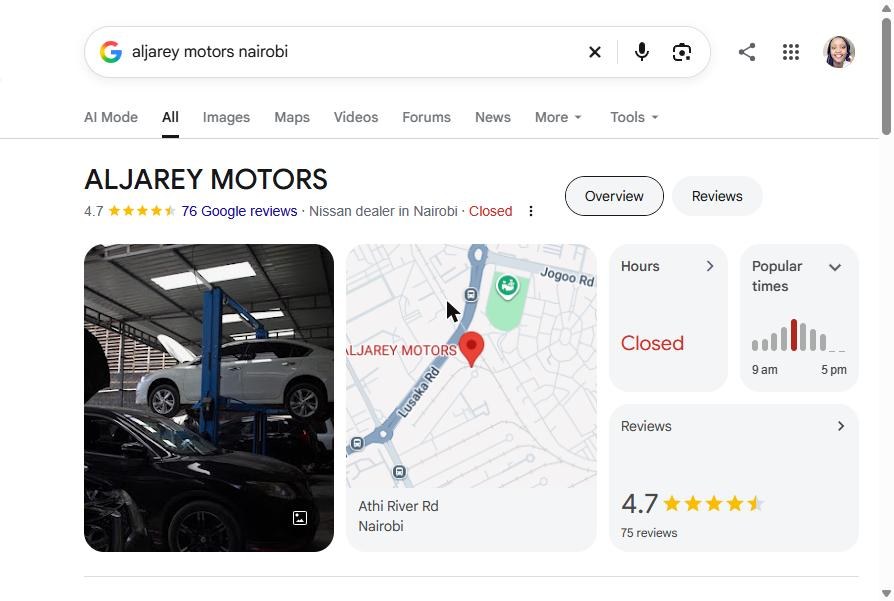
What does this look like for a real client? Aljarey Motors
Aljarey Motors is a Nissan specialist garage in Nairobi. In Kenya the person who fixes your car is a fundi, but the searches that won Aljarey the top spot were English model-and-need searches, because that is what Nissan owners type when the light comes on: "best nissan repair in nairobi" and "nissan note repair nairobi". Both are number one today.
So we wrote the pages the way owners of Notes, X-Trails, Marches and Navaras describe their problems, in their words, not in a brochure's words. That is the real lesson of this post: the right language is the one your customer uses, and for a garage that was English model names with plain, everyday descriptions. Now that the English searches are won, the next step is testing mixed phrases like "fundi wa gari nairobi" against the same pages, and keeping only what Google suggestions and Search Console back up.
Want us to check which words your buyers use? Book a call and we will do it live with you.
What about Sheng?
Sheng is alive in captions, comments, video titles and voice notes. In search it is much less common for commercial queries, and it changes fast, so a Sheng phrase can be dated within a year. Do not build core pages around it. Use it on social, where tone matters, and let search data tell you if a Sheng phrase deserves a page.
How do I add Swahili without hurting my English SEO?
Keep each page mainly in one language and bring the other in small, natural ways. Put the phrase in a heading or a short paragraph, not in every sentence. Write it the way you would say it to a customer: short, warm and plain. If you do make a full Swahili page, give it its own URL, title and description, and link the two pages to each other.
This is part of the semantic and AI-search layers in our 5-layer keyword strategy. The mixed phrasing is just more words that belong to the same topic.
What is the next step?
Pick your top service. Run the checks above. Write down the exact words you find, then use one real mixed phrase on the page where it reads naturally. Our SEO service includes keyword mapping in English, Swahili and mixed language, so you do not have to do it alone.
Find the words your buyers really use
Tell us your service and your audience. We will check the English, Swahili and mixed searches live on a free call.
Want this done for your site?
Thirty minutes with Nemo. No pitch and no pressure, just an honest look at what your website needs next.