Before we get into strategy, I want to say something that I think matters.
Lady Bishop Cathy Kiuna of Jesus Celebration Centre (JCC) runs a platform called Woman Without Limits that quietly does something extraordinary: it creates space for honest, high-achieving women to talk about their faith without pretending it has been straightforward.
If you have not watched it, the channel is here, and it is well worth your time.
The conversation I am about to reference is exactly the kind of content that makes people feel less alone in their spiritual journey.
That matters.
Thank you, Rev Cathy, for building it.
The guest on the episode that stayed with me was Michelle Ntalami, an entrepreneur and founder of Marini Naturals, and one of the most candid voices in Kenya’s public space when it comes to discussing the interior life behind achievements.
Michelle has never been someone who performs a version of herself. What she says, she means. Which is why what she shared on that episode landed so clearly. She was talking about her faith journey, the searching, the wandering, the season when she finally decided she was ready to come back to church.
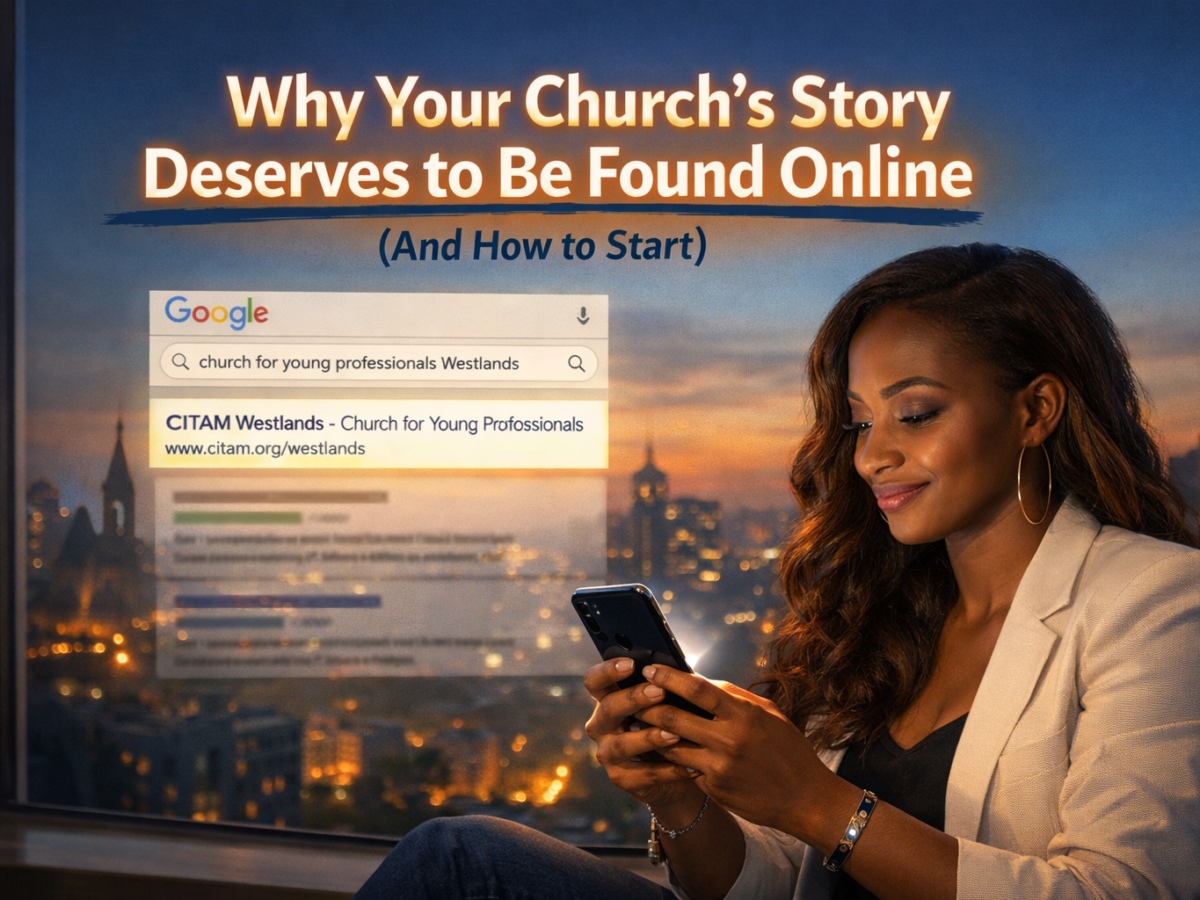
And when Rev Cathy asked how she found CITAM, Michelle’s answer was immediate and completely matter-of-fact: She Googled it. She was not invited by a friend. She did not pass the building on her way somewhere else. She was not handed a flyer or reached by an outreach programme.
She sat with her need, opened her phone, and typed something into a search bar. CITAM appeared. She walked through the door.
You can watch that conversation yourself —find it on the Woman Without Limits channel— and I encourage you to, because the fullness of what Michelle shares about that season of her life is far richer than any summary I could offer here.
But that one detail — I Googled it — has stayed with me.
Because it contains everything you need to understand about why digital presence is no longer optional for churches and ministries in Kenya. It is a mission strategy.
It is how the Michelle Ntalamis of this generation —the high-achieving, spiritually searching, quietly hungry ones— find their way home.
The question is not whether people like her are searching for what you offer.
They are.
The question is whether they find you when they do.
The shift in how spiritually curious people find churches today
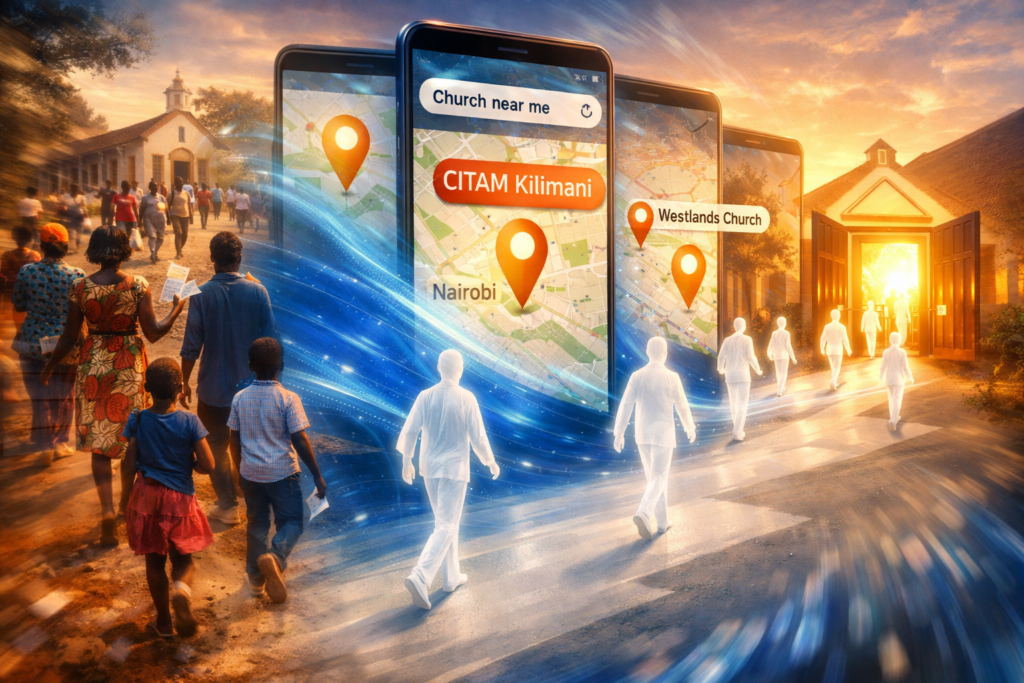
For most of church history, discovery happened through proximity and relationship.
You attended the church your family attended.
You were invited by a neighbour.
You walked past a building often enough that one Sunday, you walked in.
That still happens.
But it no longer accounts for the majority of new congregation members, particularly among the demographic that churches across Kenya are most eager to reach the:
- Young professional
- Returning prodigal
- Seeker with genuine questions and a need for a community that can hold them
That person, with extraordinary frequency, begins their search online.
Not because they are shallow or consumer-minded — but because the internet has become the first place any of us go when we are trying to understand something we do not yet know how to name.
According to Think With Google’s research on religious search behaviour, searches related to faith communities have grown significantly year on year, with strong mobile search patterns around phrases like:
- “church near me,”
- “churches in Nairobi,”
- “church for young professionals Westlands”
- “congregation that takes mental health seriously.”
Michelle Ntalami is not unusual.
She is representative of an entire generation of spiritually searching people who will either find their community or not, based on what appears when they open Google.
What CITAM did right (and what most churches are not doing)
The fact that CITAM appeared in Michelle’s search was not accidental.
It was the result of years of investment in exactly the kind of digital presence that makes a church findable:
- a complete Google Business Profile,
- a website with specific location and community information, a consistent content presence,
- and enough of a digital footprint that Google had strong confidence that CITAM was a genuinely relevant result for someone searching for a church in Nairobi.
Most churches in Kenya have the opposite.:
- A website built five years ago with service times and a photo of the building.
- A Facebook page that is occasionally updated.
- A Google Business Profile that was never claimed or was set up once and forgotten.
None of that is enough to surface your church to someone doing the search Michelle Ntalami did.
The gap between the churches that are found and those that are not is rarely a gap in genuine community, depth of teaching, or quality of pastoral care.
There is almost always a gap in digital visibility. And that gap is entirely fixable.
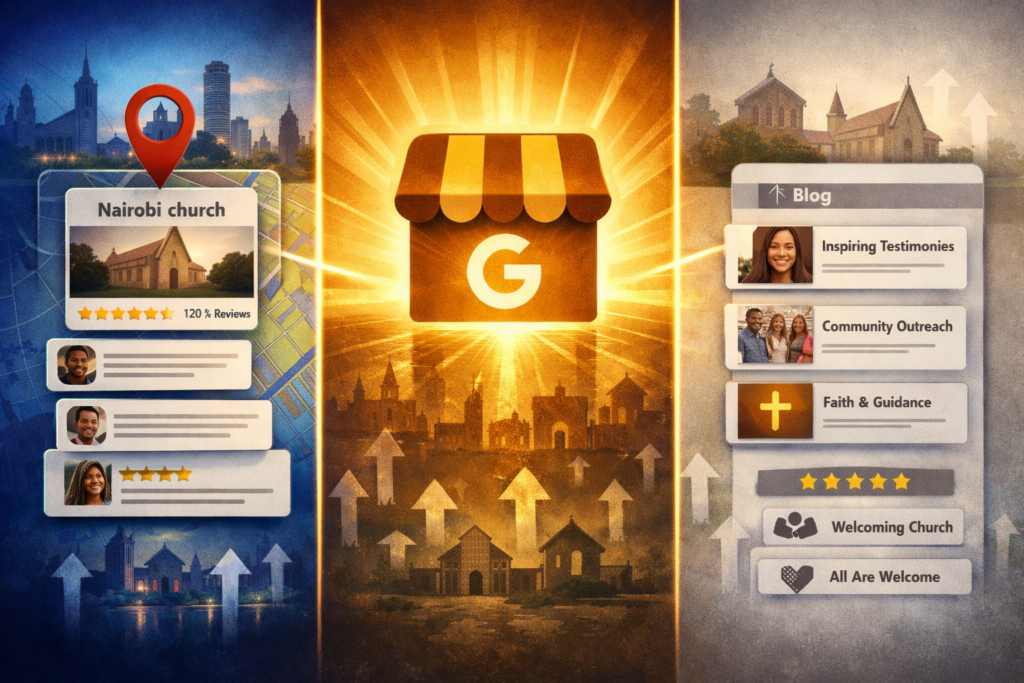
The three things that actually determine whether your church gets found
One: your Google Business Profile
This is the single highest-impact, lowest-cost action any church in Kenya can take right now.
When someone searches “church in Kilimani” or “Pentecostal church Westlands Nairobi,” Google pulls results primarily from Business Profiles —the entries that appear on Google Maps and in the sidebar of search results.
If your church does not have a fully completed Google Business Profile, you are invisible in those searches.
Completely.
Regardless of how good your website is.
- A complete profile means:
- Accurate address and service times,
- A genuine description written for someone who has never heard of you,
- Photos of your space and your people (not just the building exterior),
- Regular responses to reviews and questions.
- Google treats an active profile as a strong signal of relevance.
It can make you visible in local searches within weeks.
Two: a website written for seekers, not just members
Read your church’s About page right now.
Is it written for someone who already knows what “Spirit-filled congregation” means and is looking for specific information — or is it written for someone who has never been inside a church as an adult and is trying to understand whether your community is a place where they would belong?
Most church websites are written entirely for the former.
They describe theological positions, list programmes, and announce events. All of that is necessary — but it does almost nothing for the person doing Michelle’s search.
That person wants to know:
- What does it feel like to walk in for the first time?
- Who are the people here?
- What happens on a Sunday morning?
- Is this a place where someone like me would be welcome,
- or would I feel like I’m missing context that everyone else has?
Writing your website to answer those questions — honestly, warmly, specifically— is better SEO and better ministry. It is the same thing.
Three: content that builds trust before the first visit
This is the most underused strategy in church digital presence and the one with the highest long-term return.
A church that publishes genuinely thoughtful, accessible content —on faith and work, on navigating doubt, on mental health and faith, on what it means to be a Christian in contemporary Kenya— does something that no directory listing or Google Business Profile can do: it gives a spiritually curious person a reason to trust you before they ever set foot inside your building.
HubSpot’s research consistently shows that organisations publishing genuinely helpful content regularly receive dramatically more inbound interest than those that do not — and the effect compounds over time.
A church with two years of thoughtful monthly posts will attract a fundamentally different level of organic search traffic than a church that has published nothing.
More importantly, the person who found you through three blog posts that resonated with them has already started to trust you.
They walk through your door with a completely different posture than someone who just saw your building on their way to work.
What a realistic digital presence plan looks like for a church or ministry
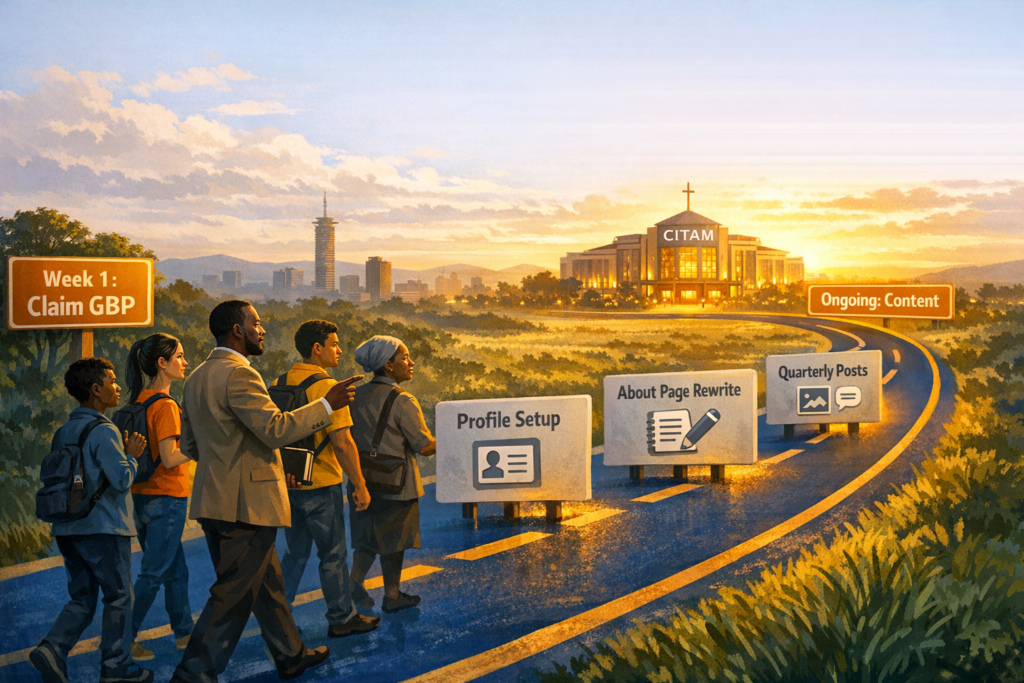
You do not have a full communications team. Very few churches in Kenya do. Here is what is realistic and genuinely impactful:
This week: Claim and complete your Google Business Profile if you have not already. This takes two hours and has an immediate impact on local search visibility.
This month: Rewrite your About page and homepage with the spiritually curious newcomer in mind. Ask: What would Michelle Ntalami need to read to decide this church was worth visiting?
Quarterly: One genuine piece of content —a blog post, a written reflection, a series summary— on a topic your community actually engages with. Not a press release. Real, considered thinking that someone outside your congregation would find genuinely useful.
Ongoing: Stay active on your Google Business Profile. Respond to reviews. Update your service information when it changes. Post occasional photos. This takes perhaps twenty minutes a month and has a disproportionate impact.
The deeper thing this is really about

There is a version of church digital strategy that is purely transactional — growth hacking, conversion funnels, optimising for attendance numbers.
That is not what I am describing, and I suspect it is not what you want. What I am describing is stewardship.
If your community is genuinely doing something good — building real relationships, offering genuine pastoral care, creating space for honest spiritual exploration — then the people searching for exactly that deserve to be able to find you.
Michelle Ntalami found CITAM because CITAM was findable.
That is the whole story. And somewhere right now, someone is searching for a church that would be the perfect answer.
Whether they find you is a decision you can make.
If you would like to talk through what a content strategy for your specific church or ministry would look like —what is realistic, what would have the most impact, what you can do independently, and what would benefit from a content partner— the Clarity Call is free and entirely without obligation.
You can also read our piece on why faith-based professionals stay invisible online for the broader strategic context that applies equally to ministry digital presence.
Your community is doing something worth finding.
Let us make sure people can find it.
